Research

My research uses machine learning to reduce the cost of electronic-structure screening and atomistic simulation. Current projects address rare-property retrieval in metal–organic frameworks and machine-learned interatomic potentials for quantum hydrogen transport in MoS₂.

Research Projects

Enrichment-driven discovery of low-band-gap metal–organic frameworks

Only 74 of the 10,810 HSE06-labelled QMOF structures have band gaps at or below 1 eV. The study therefore formulates screening as top-k retrieval under a fixed HSE06 validation budget rather than as global regression over the full chemical space.

The ranking workflow combines a fine-tuned PMTransformer regressor with an ExtraTrees rare-class classifier trained on frozen pretrained embeddings. Reciprocal-rank fusion combines the rankings; model disagreement provides an exploration signal; and selection in independent structural representations enforces chemical diversity.

The prospective screen covers 9,561 unlabelled QMOF structures and 13,802 generated frameworks. Forty-eight candidates enter staged PBE-D3(BJ)/HSE06 validation, yielding 41 reportable HSE06 results and nine structures at or below 1 eV: three QMOF structures and six generated frameworks. The generated hits are also checked against four reference databases and analysed by projected density of states.

  • Manuscript: Ege Yiğit Erbil, Ömer Veysel Çağatan, and Büşra Dereli. Under peer review (2026).[ORCID]
  • Code and research materials:[GitHub][Data][Software]
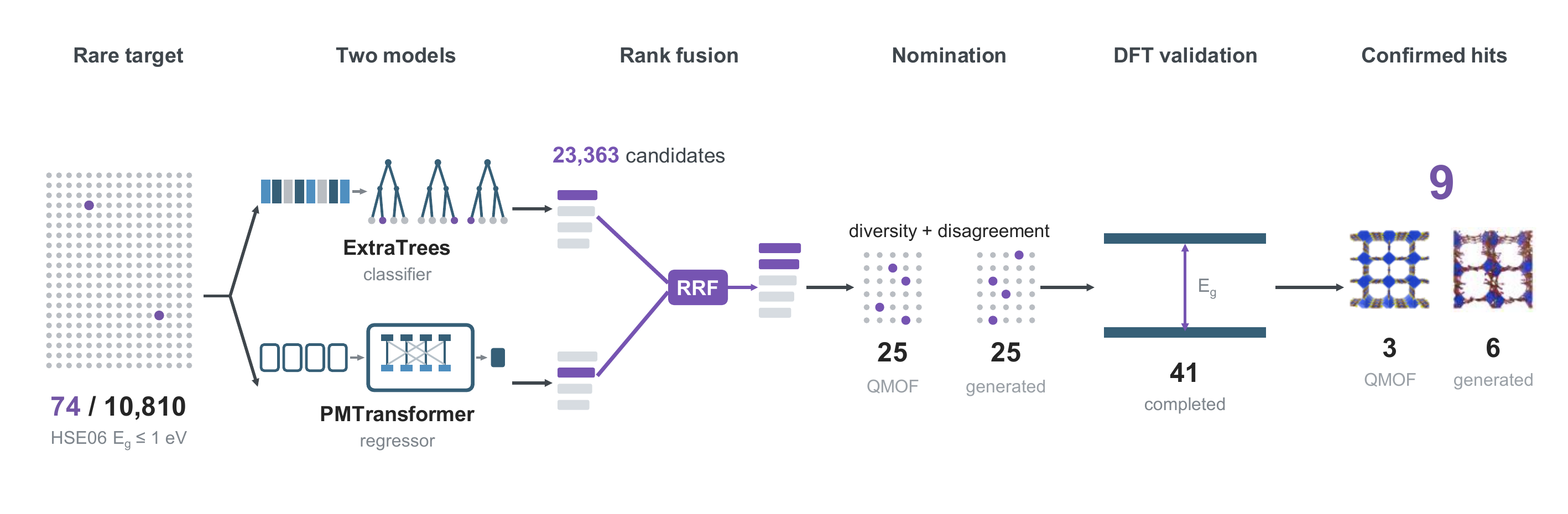
Rare-property retrieval workflow from labeled MOF data through machine-learning ranking and HSE06 validation
Workflow for ranking, nomination, and HSE06 validation.

Capturing Nuclear Quantum Effects in Hydrogen Diffusion through MoS₂ via Machine-Learning-Enhanced Path-Integral Simulations

Classical-nuclei simulations do not capture the nuclear quantum effects relevant to hydrogen and deuterium diffusion. The study trains a MACE interatomic potential on r²SCAN+rVV10 data and combines it with path-integral molecular dynamics and well-tempered metadynamics.

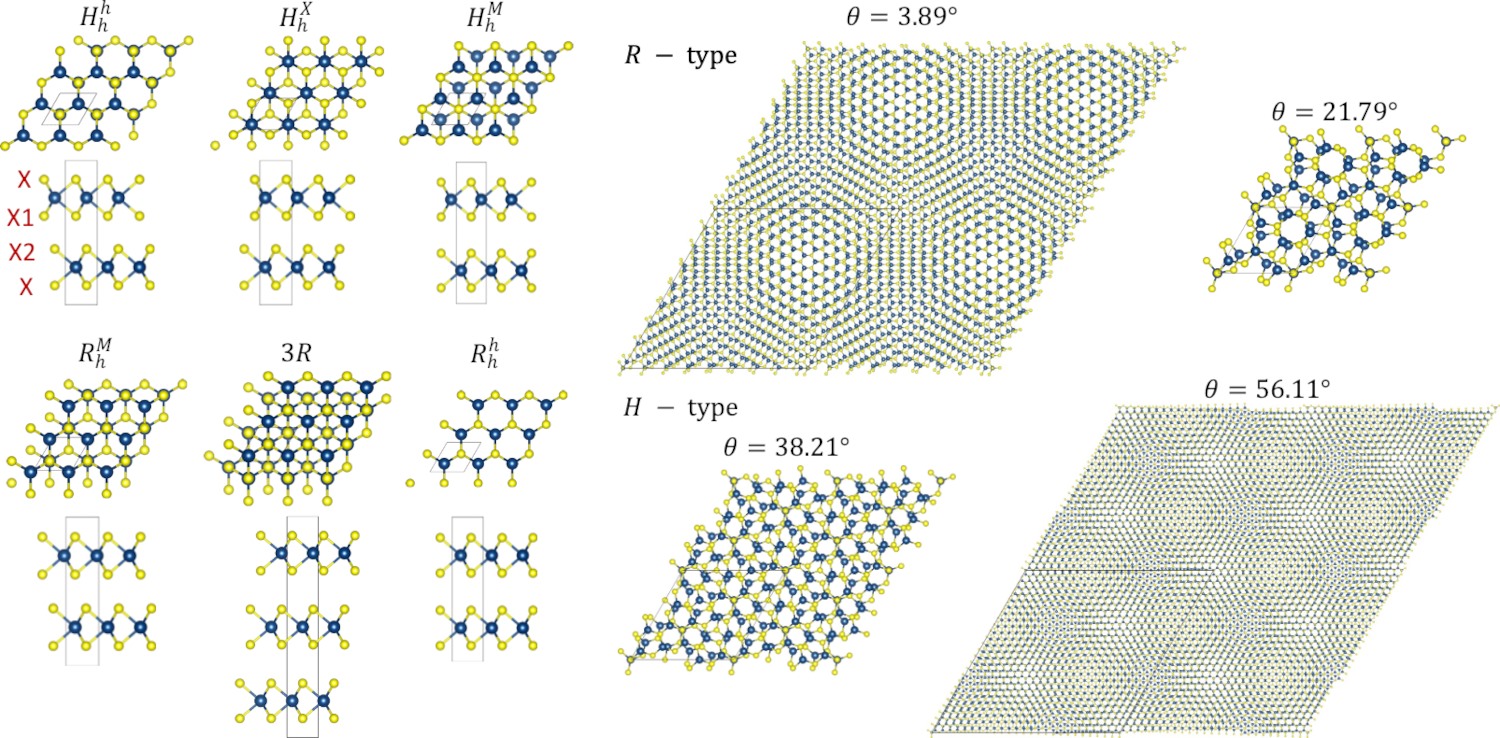
The calculations cover several MoS₂ polytypes and reconstructed twisted bilayers. The results quantify changes in diffusion barriers, hydrogen–deuterium isotope selectivity, and the dependence of transport on local stacking environments in moiré superlattices.

  • Manuscript: İsmail Eren, Ege Yiğit Erbil, Maria-Judith Caisachana-Lozada, Hossein Mirhosseini, Thomas D. Kühne, and Agnieszka B. Kuc. Under peer review · arXiv v2 (2026).[Preprint][arXiv DOI][ORCID]
Atomic structures of high-symmetry and twisted-bilayer molybdenum disulfide systems
High-symmetry MoS₂ stackings and representative twisted bilayers studied in the manuscript.